A First Community Film Night Built Around Short Local Stories
Plan a first community film night with a thoughtful running order, clear transitions and room for short local stories to meet their audience.
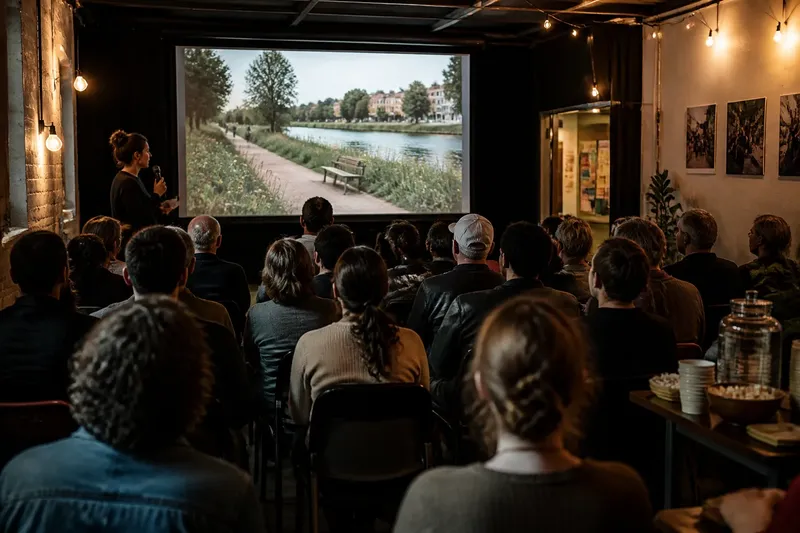
The common mistake at a first community film night is to treat short local films as small features: line them up, press play, and hope the room stays with them. The cost is subtle but real: one story can crowd out the next, while viewers leave without a chance to connect what they have seen to the place they share.
A better occasion gives each film breathing room without turning the evening into a production. Think of the programme as a sequence of encounters: a welcoming start, a varied run of films, a pause to reset, and an unhurried ending.
How should the first community film night begin?
Start with a brief welcome that tells people what kind of evening they have entered. Mention who gathered the films, how long the screening will run in broad terms, and whether conversation is planned afterwards. Keep the introduction warm and plain; a long speech can make a modest gathering feel formal before the first image appears.
Give the room a moment to settle. Ask someone to check that the entrance is easy to find, that late arrivals can come in quietly, and that the person introducing the films knows how to reach the projectionist. These small roles need not be assigned with ceremony, but clarity keeps attention on the screen.
Say what viewers can expect from the films without explaining their meanings. A simple note that the programme includes neighbourhood memories, everyday work or local landscapes gives people a useful frame, while leaving the films to speak for themselves.
What order helps short local stories feel distinct?
Build a sequence around contrast rather than resemblance. If several films share a subject, vary their mood, pace or visual texture. A quiet portrait might sit well beside a lively street scene; a film with little dialogue can follow one driven by voices. The point is not to create a clever puzzle, but to help viewers notice each work on its own terms.
Consider the first film an invitation, not the most demanding piece in the collection. A clear, welcoming opening can help the room settle into the screening. Place a more reflective or formally unusual film later, once viewers have found their footing, and avoid ending on a work that feels like an abrupt stop if the gathering is meant to continue.
Imagine you have four films: one follows a baker opening a shop, one gathers sounds from a riverside path, one is a comic portrait of a local club, and one records residents describing a changing high street. You might open with the riverside piece, move to the baker, use the club film to lift the pace, then close with the high-street voices. That order moves from atmosphere to character, lightness and reflection; another group might choose differently, but the sequence has a discernible rhythm.
- Check each film’s stated running time and include introductions or credits in your overall plan.
- Note whether a film needs a short context-setting sentence from its maker.
- Look for repeated subjects or visual styles that could make adjacent films blur together.
- Choose a final film that leaves the room able to stay, talk or simply sit for a moment.
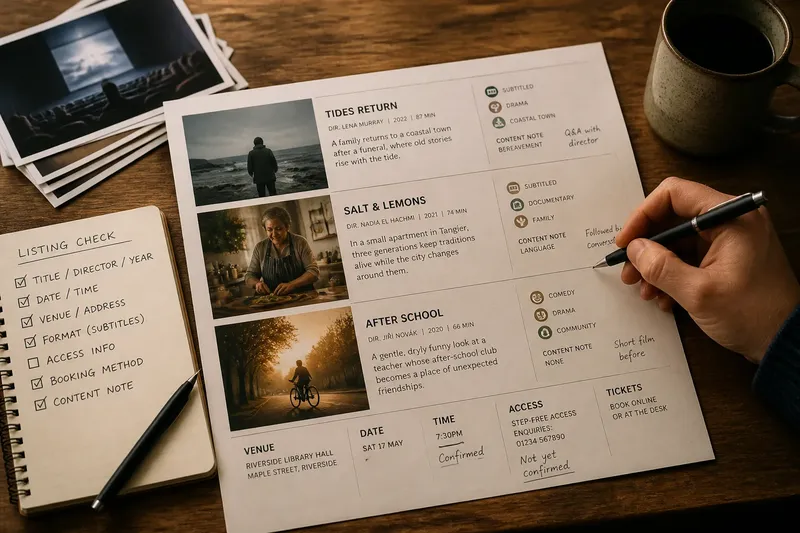
- Keep a printed running order near the person handling playback.
Where do pauses belong in a compact programme?
Short films still ask for sustained attention. A pause between every item can break the spell, but a continuous block may leave no space for a stretch or a quiet word. Group the films into a small number of clusters, then make one clear interval where people can move about, get water and return without missing a story.
Use transitions deliberately. A host can announce the next cluster in a sentence, or simply leave a breath between titles. Avoid filling every gap with commentary: silence can let an image or sound linger, and the next film often benefits from arriving without explanation.
For a modest event, keep refreshments simple and place them away from the screen and speakers. If the room has a separate foyer or side table, use it; rustling wrappers and a queue crossing the view can turn a thoughtful pause into a distraction.
What should the host do before the doors open?
Make the viewing conditions predictable. Check that the screen is visible from the back and sides, that captions can be read, and that the room is not so bright that dark scenes disappear. Confirm that the playback files open in the intended order and that the sound is clear at the seats, not only beside the equipment.
Prepare a simple fallback for a delay: a short welcome, a clear update to waiting viewers, and a person who can answer practical questions. Avoid promising a precise finish if the programme includes discussion; instead, tell people when the films are expected to end and how the conversation will work.
Where a film includes sensitive material or identifiable people, check that the organiser has permission to screen it and that any audience notice is considerate and specific. For technical or rights questions, follow the relevant venue, distributor or filmmaker guidance rather than improvising.
What do viewers ask about a first community film night?
How many short films should the programme include?
Choose a number that leaves room for a welcome, transitions and the kind of ending you want. A compact selection with distinct voices usually feels more generous than a long run that pushes conversation to the door.
Should filmmakers introduce their own work?
Invite makers to speak if they want to, but make the format optional and brief. A host can introduce the film for anyone who prefers to watch without giving a public account of their process.
Can the screening include films with very different styles?
Yes, provided the order gives viewers a way to move between them. Varying tone and form can make local filmmaking feel alive; a short transition can help the audience reset without explaining what to think.
How should the evening end if there is no formal discussion?
Thank the makers and the people who helped, then make clear whether the room remains open for informal conversation. Leave viewers an easy way to find the programme or contact the organisers if they want to follow up.
How can the ending leave the room open?
Do not let the last credit roll become the only signal that the evening is over. Bring the lights up gently, thank the contributors by role or name where appropriate, and offer a simple invitation to stay. People may want to speak with a filmmaker, compare impressions or head straight home; none should feel obliged to perform enthusiasm.
A first community film night succeeds through attention to these modest choices: a sequence with rhythm, pauses that respect the room, and a welcome that makes participation easy. Keep the running order visible, leave a little space after the final image, and let the local stories carry the evening beyond the screen.