From Film Listings to a Season with a Point of View
Turn film listings into a curated season with a clear thread, thoughtful pairings and concise notes that help audiences choose what to see and notice.
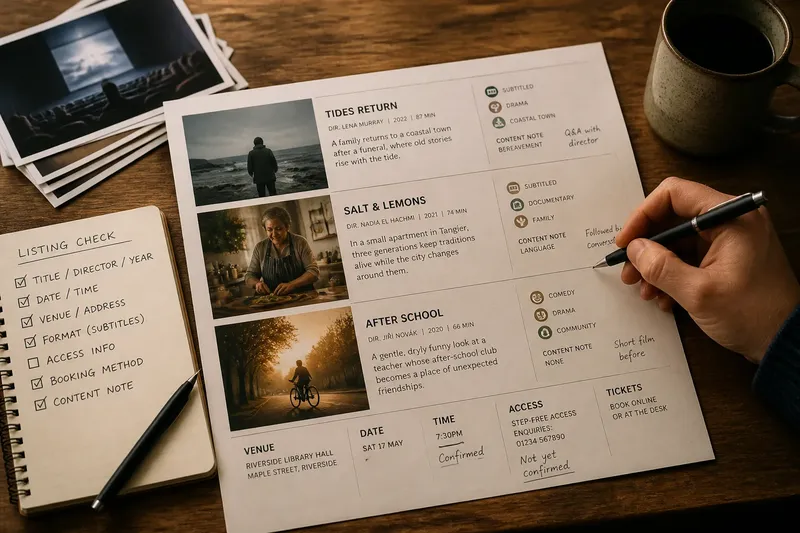
The common mistake in a film programme is to treat the leaflet as a warehouse: every appealing title gets a slot, and the audience is left to supply the connection. The cost is practical as well as artistic: people may not know which screening suits them, and a strong film can get lost among vague descriptions. A curated film programme can still be lively and varied, but each listing should help a reader make a choice.
What does a useful film listing tell a reader?
A listing has a small job: identify the film, make the event easy to understand and help someone decide whether to come. Include the title, director, year and running time when those details are available, along with the venue, screening date and any access information the audience needs. Keep the description focused on the film rather than the organiser’s enthusiasm.
For an unfamiliar title, give a plain-language premise and one detail that sets it apart. “A family returns to a coastal town after a funeral” gives a reader something concrete; “a moving exploration of belonging” tells them much less. If the film uses subtitles, is silent, or has a format that affects the experience, say so clearly.
Decide what a person needs before booking, then put that information where they will see it.
How can a programme help people choose between screenings?
People often scan listings on a noticeboard, a society website or a printed leaflet. Make the differences between events visible at a glance: a short description, a clear content note where relevant, and a concise indication of the film’s tone or form. Avoid giving away a turn that viewers are meant to discover.
Imagine a society has scheduled two films on the same evening at different community venues. One is a quiet documentary with subtitles; the other is a brisk comedy with a post-screening discussion. If the listings say only “an absorbing film” and “a delightful film”, readers have little basis for choosing. Naming the format, tone and discussion plan makes the options clearer without ranking them.
Practical details belong beside the description, not buried in a separate announcement. State whether tickets need to be booked, how to ask about step-free access, and whether the venue has a particular entry arrangement. If a detail is not confirmed, avoid presenting it as settled; give readers a contact route instead.
Which details should every screening notice check?
Before publishing, review each notice against the information a prospective audience member will use. For every item, check the actual listing; if it is accurate and complete, publish it, but if it is uncertain or missing, confirm it with the venue or organiser before making a promise.
- Film identification: Check the title, director and release year against the booking record; if they match, keep them, but if they conflict, confirm the correct version before publication.
- Screening time: Check the date and start time against the venue schedule; if confirmed, publish both, but if the schedule is provisional, mark the event details as pending or wait.
- Venue: Check the venue name and street address against the organiser’s confirmation; if both agree, use them, but if the location has changed, update the notice and remove the old address.
- Film format: Check whether the screening is subtitled, silent or presented in another format that affects viewing; if confirmed, state it plainly, but if unknown, ask the distributor or screening organiser rather than guessing.
- Access information: Check the venue’s current access details and contact route; if the information is confirmed, include it, but if it is incomplete, invite readers to contact the venue instead of making an assumption.
- Booking method: Check whether a reservation is required and which booking channel is active; if confirmed, provide that route, but if no booking arrangement is set, say how readers can ask about attendance.
- Content note: Check for material the organisers have identified as relevant to audience choice; if a clear note is available, state it briefly, but if it is not, avoid inventing a warning and seek clarification.
Say you are preparing a notice for an invented screening of a subtitled documentary at a library hall. The organiser’s draft gives the film title and date, but the venue has not confirmed the start time or step-free entrance. You check the title against the booking email, retain the confirmed date, ask the venue about the two missing details and hold the notice until it replies. If the venue confirms the time but cannot verify the entrance, you publish the time and give the venue’s contact route for access questions; the result is a useful listing without an unsupported promise.
How should descriptions handle unfamiliar films?
Explain enough for a reader to picture the viewing experience, not enough to replace it. A concise description can name the setting, central situation and style. For a film with an unfamiliar cultural or historical context, provide the detail that helps the audience follow the event, and avoid using a broad label as a substitute for specifics.
Distinguish a factual description from an interpretation. “The story follows a nurse working through a night shift” describes the premise. “A meditation on the cost of care” offers a reading. Either can be useful, but a listing should not present an interpretation as the only way to understand the film.
When a title is part of a pairing or themed event, explain the practical link in a sentence, such as a shared setting or contrasting approach. Give each film its own description, too; a reader should not have to understand a curator’s wider argument before deciding whether to attend.
What questions do readers ask before booking?
Should a listing include spoilers?
No plot turn is needed to help someone choose. Describe the premise, tone or form, and leave surprises intact unless a detail is essential for informed attendance.
How long should a film description be?
Keep it short enough to scan and specific enough to distinguish the film from the next listing. If a sentence repeats the title’s mood without adding a concrete detail, cut or rewrite it.
Should organisers include a content note?
Include a concise, relevant note when the organisers can identify material that may affect someone’s decision to attend. Use plain language, and avoid guessing about content that has not been checked.
What if screening details are not confirmed?
Do not fill gaps with assumptions. Confirm the information with the venue or organiser, or tell readers how to ask for an update while the details remain unsettled.
How can the leaflet stay clear across different venues?
Use the same order for core details in every listing so readers know where to look. For example, place the film title and short description first, followed by the date, venue, access information and booking route. Consistency helps people compare events without forcing every film into identical promotional language.
Check the finished leaflet at the size and in the setting where people will read it. A notice on a community centre board may be viewed from a few steps away; a web listing may be opened on a phone. If essential details disappear in a crowded layout, simplify the design or move less urgent copy elsewhere.
Keep the tone inviting, but let precise details do the work. “A tense courtroom drama, screened with subtitles” gives readers a clearer picture than a string of superlatives.
How can organisers keep listings accurate as plans change?
Give one person responsibility for updating the master copy, and make sure the same version feeds the website, printed notices and social posts. When a venue or time changes, correct every live channel and tell anyone who has already booked through the route available to the organiser.
Before printing, ask the venue to confirm its name, address, start time and access details. Before an online notice goes live, check that its booking link works and that the description matches the film being screened. If a change arrives after printing, post a clear correction at the venue and on the society’s online channels.
A clear curated film programme does more than sound polished: it helps people understand what is on, what to expect and how to attend. For each listing, check whether a newcomer could make an informed choice from the information provided. That small editorial check can make the next screening easier to find and easier to join.