The post-screening conversation starts with one good question
A good post-screening conversation question helps a group move beyond quick verdicts and share what they noticed, without putting anyone on the spot.
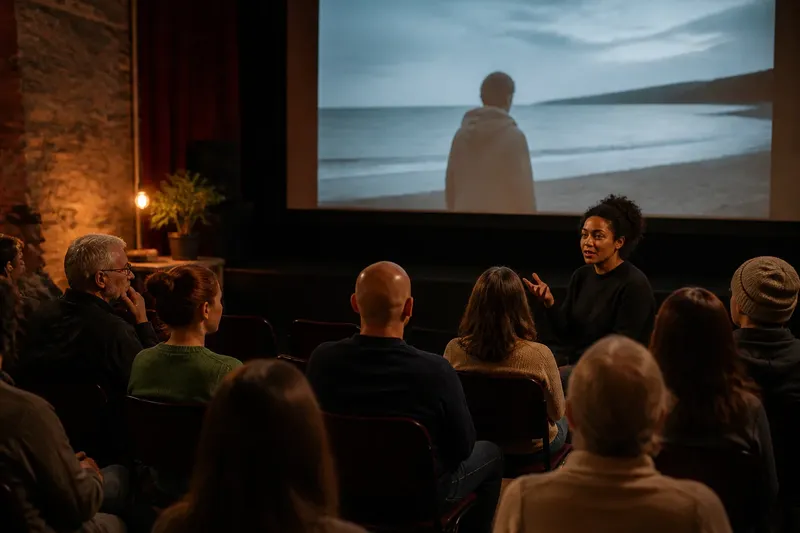
The familiar mistake after a screening is to ask, “Did you like it?” The answers arrive quickly—yes, no, perhaps—and the conversation can stop before anyone has said what the film made them notice. A well-chosen post-screening conversation question gives people a gentler way in: it invites a specific memory or response, without asking anyone to perform as a film expert.
That matters in a film society, a library room or a small independent cinema. People may have watched closely, felt uncertain, or simply be waiting for a cue. The person who opens the discussion does not need a lecture or a list of clever interpretations. They need one question, a moment of quiet and the willingness to follow what the group actually says.
What makes a question open enough?
An open question cannot be answered with a bare yes or no. It points towards an aspect of the film but leaves room for different memories, feelings and readings. “What stayed with you after the ending?” is more inviting than “Was the ending good?” The first asks for a response; the second can sound like a verdict is expected.
Useful prompts tend to focus on something people can recall: a sound, a gesture, a change in mood, a setting, or a moment when their attention shifted. They do not require the group to agree on what the director intended. A viewer can speak about a scene’s effect without claiming to know its hidden meaning.
Try a question that points to an experience, not a correct answer.
When should you ask it?
Let the screening finish properly before beginning. Give the room a little space to absorb the closing image, credits or silence. If the venue needs to clear promptly, a brief pause still helps distinguish the conversation from an announcement about coats, chairs or the next event.
Once people are settled, ask one question in a natural voice. Keep it short enough to hold in memory. Then wait. A pause may feel longer to the person who asked than it does to the audience; resist filling it with a second prompt, a personal interpretation or an apology for the question.
If the first response is brief, thank the speaker and leave the question open to others. You might say, “Did anyone notice something different?” Avoid immediately translating the comment into film terminology. The point is to make room for the group, not to show that the facilitator can name every technique.
How do you choose a prompt that fits the film?
Think back to what the film gave the audience to notice. A quiet drama may leave viewers with a charged silence or an unresolved exchange. An animated short may invite attention to a repeated shape, a change in colour or the way movement carries emotion. A documentary screening might prompt discussion of a moment when the film’s closeness to a subject felt especially clear.
Choose one doorway rather than trying to cover the whole film. For instance, a question about sound can lead into memory, tension or atmosphere without requiring a technical discussion of microphones and mixing. If the film has an ambiguous ending, ask what people were left wondering, rather than demanding a single explanation.
Say you have just screened a short film in which a character keeps leaving messages unanswered. You might ask, “Was there a moment when your view of the silence changed?” One person could recall a pause that felt funny; another might describe it as painful. The question makes room for both responses and gives the group a concrete moment to discuss.
How can you keep the conversation shared?
After the first response, invite connection rather than turning to a prepared sequence of questions. “Did that moment land differently for anyone?” can bring in another viewer without suggesting that the first person was wrong. A short follow-up such as “What gave you that impression?” asks for detail while leaving the speaker in charge of their own reading.
Watch the shape of the room. If one confident voice takes up the space, thank them, then open the floor: “I’d like to hear from someone who hasn’t spoken yet, if they’d like to join in.” Do not call on a person who appears uncomfortable. If several people speak at once, briefly repeat the question and invite one response at a time.
Not every comment needs a reply from the facilitator. A nod, a pause or a simple “Thank you” can let one thought settle before another begins. If someone asks what the film was “really about”, turn the question back towards the room: “What in the film led you to that idea?” This keeps interpretation collaborative rather than handing down a ruling.
What questions do viewers often have about discussion prompts?
What is a good question after a film screening?
Ask about a specific response that can have more than one answer, such as “Which moment has stayed with you?” It is easy to understand, but gives each viewer room to choose what mattered.
How long should a post-screening conversation last?
Let the room, venue and audience shape the discussion rather than aiming for a fixed duration. End when the group has reached a natural pause or the venue needs the space, and say plainly that it is time to wrap up.
What if nobody answers the question?
Wait for a moment, then offer a small invitation: “You could mention a scene, a sound or a feeling.” If the room remains quiet, share your own brief response and reopen the question, without treating silence as a failure.
Should the facilitator explain the film’s meaning?
Not as a requirement. The facilitator can share an observation, but should distinguish it from fact and leave space for readings that differ.
How do you close without shutting down discussion?
When the conversation begins to circle or people need to leave, acknowledge a detail the group has brought forward. You might say, “We’ve heard how that pause felt comic to some people and unsettling to others.” This recognises the exchange without declaring one reading the winner.
Then offer a clear closing line and, if appropriate, mention any practical next step, such as where to return a borrowed programme or how to find the society’s next screening. Do not tack on a last, large question when coats are already being gathered. A tidy ending respects both the conversation and the people who shared it.
For a post-screening conversation, the best question is not the one that sounds most sophisticated. It is the one that helps someone point to a real moment and say what it did for them. Keep that aim in mind, and a room of different viewers can make meaning together without needing an expert at the front.